
Choosing the wrong gearbox ratio is one of the most common mistakes when specifying a conveyor drive.
The motor may be correctly selected, but if the gearbox ratio does not match the required conveyor speed, the belt can run too fast, too slowly, or fail to deliver enough torque.
The good news is that calculating the correct ratio is straightforward. You only need the right numbers and a simple calculation.
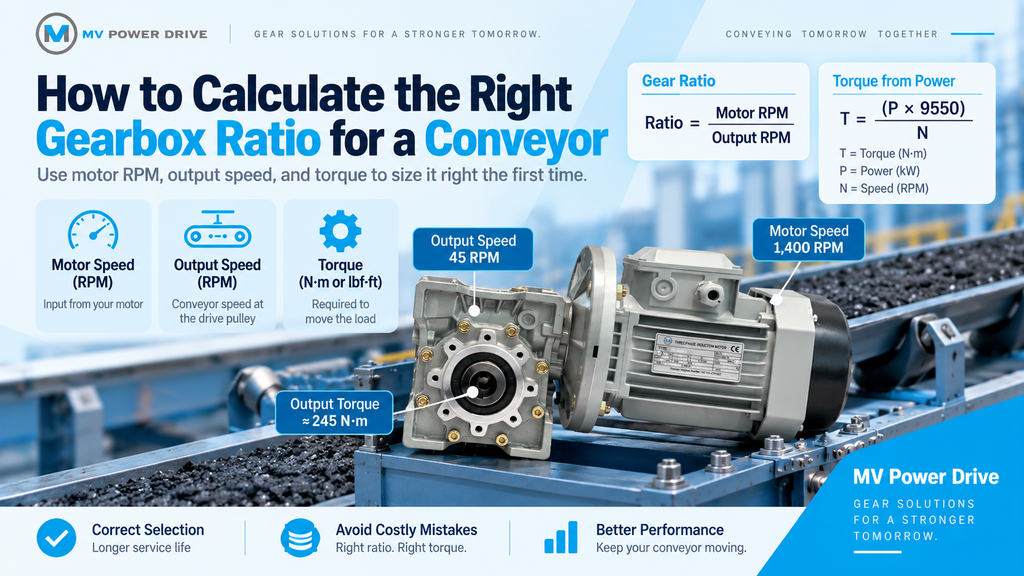
The Three Numbers You Need
Before selecting a conveyor gearbox, you need three key numbers:
- Motor speed: The motor’s RPM
- Required output speed: The RPM needed at the conveyor drive pulley
- Required torque: The torque needed to move the conveyor load
These numbers help you select the correct gearbox ratio and make sure the gearbox can handle the required load.
For example, a standard four-pole three-phase motor operating on a 50 Hz supply typically runs at around 1400 RPM under load.
The required output speed depends on your conveyor design. You can calculate it from the required belt speed and the diameter of the drive pulley.
How to Calculate the Conveyor Gearbox Ratio
The basic formula is:
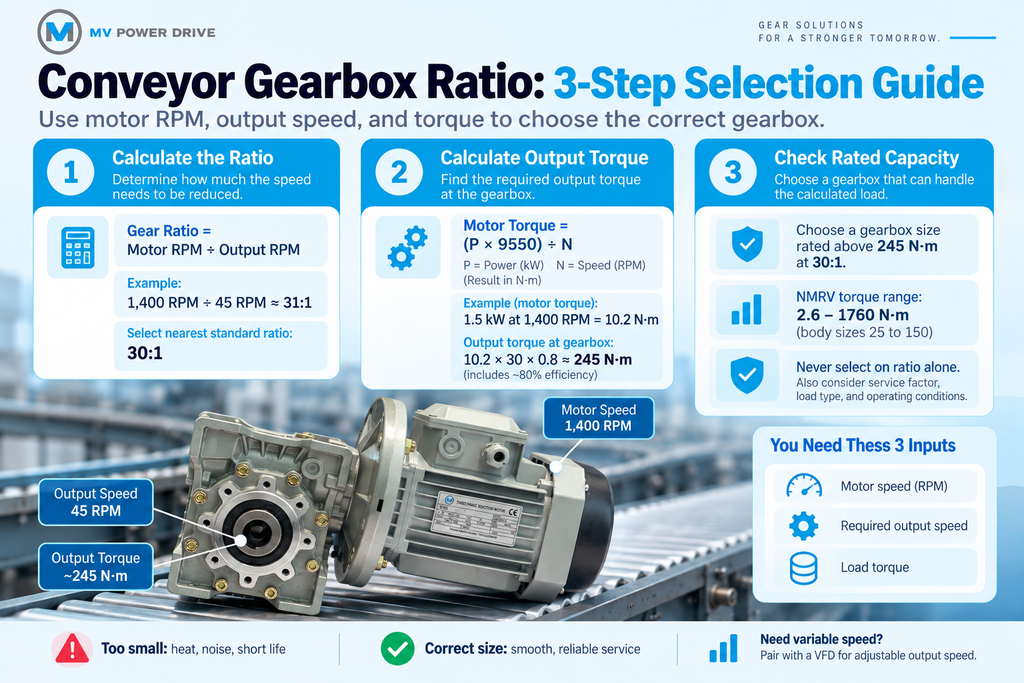
Gearbox Ratio = Motor Speed ÷ Required Output Speed
Let’s look at a practical example.
Worked Example: 1.5 kW Conveyor Motor
Suppose your conveyor requires the drive pulley to rotate at 45 RPM.
Your motor has these specifications:
- Motor power: 1.5 kW
- Motor speed: 1400 RPM
- Required output speed: 45 RPM
Step 1: Calculate the Gearbox Ratio
Use the formula:
Ratio = 1400 ÷ 45
Ratio = 31.1:1
So, you need a gearbox ratio of approximately 31:1.
In practice, you would select the nearest available standard ratio. For an NMRV worm gearbox, a 1:30 ratio may be a suitable option, provided the output torque and service requirements also match.
NMRV worm gearboxes are available in a wide range of ratios and body sizes, so ratio alone should not determine your selection.
Step 2: Calculate Motor Torque
After calculating the ratio, you need to check the torque.
You can calculate motor torque using this formula:
T = (P × 9550) ÷ N
Where:
- T = Torque in Nm
- P = Motor power in kW
- N = Motor speed in RPM
For a 1.5 kW motor running at 1400 RPM:
T = (1.5 × 9550) ÷ 1400
T ≈ 10.2 Nm
So, the motor produces approximately 10.2 Nm of torque at its shaft.
Step 3: Calculate Gearbox Output Torque
The gearbox increases torque while reducing speed.
You can estimate the output torque using:
Output Torque = Motor Torque × Gearbox Ratio × Efficiency
For this example, assume:
- Motor torque = 10.2 Nm
- Gearbox ratio = 30:1
- Gearbox efficiency = 0.80
The calculation becomes:
10.2 × 30 × 0.80 = 244.8 Nm
So, the estimated output torque is approximately 245 Nm.
This gives you a useful starting point when checking the gearbox’s rated torque.
Check the Gearbox Torque Rating
This is one of the most important steps in gearbox selection.
Do not select a gearbox based on the ratio alone.
The same ratio can be available in different gearbox body sizes, but each size can have a different torque capacity.
For example, MV Power Drive supplies NMRV worm gearboxes covering a broad torque range, from approximately 2.6 Nm to 1760 Nm, depending on the gearbox size and configuration.
For a calculated requirement of around 245 Nm, you need to select a gearbox with a rated output torque that comfortably exceeds the actual application requirement.
You should also consider the conveyor’s:
- Load
- Operating hours
- Starting conditions
- Shock loads
- Duty cycle
- Required service factor
Always check the manufacturer’s torque rating for the exact gearbox size and ratio before placing an order.
Why Correct Gearbox Sizing Matters
Selecting the correct ratio is only part of the process. The gearbox also needs enough torque capacity for the application.
An undersized gearbox can operate above its rated torque. This can cause:
- Excessive heat
- Increased noise
- Faster gear wear
- Bearing damage
- Reduced gearbox life
- Unexpected downtime
An oversized gearbox can also create unnecessary costs. It may increase the equipment price, weight, and installation requirements without providing a real benefit.
The goal is to select a gearbox that matches the conveyor’s speed, torque, duty, and operating conditions.
What If You Need Adjustable Conveyor Speed?
Some conveyors do not need one fixed speed.
If you need to adjust the conveyor speed during operation, you can combine the gearbox with a variable frequency drive (VFD).
A VFD allows you to adjust motor speed electronically. This can give you greater control over the conveyor’s output speed without relying entirely on a different mechanical gearbox ratio.
However, the gearbox still needs to provide the required torque and withstand the application’s operating conditions.
Second Example: Using a 900 RPM Motor
The same calculation works with different motor speeds.
Suppose you use a six-pole motor running at approximately 900 RPM, while the conveyor still requires an output speed of 45 RPM.
Step 1: Calculate the Ratio
Ratio = 900 ÷ 45
Ratio = 20:1
So, you need approximately a 20:1 gearbox ratio.
Step 2: Calculate Motor Torque
For the same 1.5 kW motor:
T = (1.5 × 9550) ÷ 900
T ≈ 15.9 Nm
The motor produces more torque at 900 RPM than at 1400 RPM because the power rating remains the same while the motor speed is lower.
Step 3: Calculate Output Torque
Using a 20:1 ratio and assuming 80% gearbox efficiency:
15.9 × 20 × 0.80 ≈ 254 Nm
The estimated output torque is approximately 254 Nm.
Notice that the output torque is close to the first example.
The reason is simple: both motors have the same power rating and both deliver the same required output speed. The lower-speed motor needs a lower gearbox ratio, while the higher-speed motor needs a higher ratio.
A Simple Formula to Remember
For most basic conveyor gearbox calculations, start with these three formulas:
Gearbox Ratio = Motor RPM ÷ Required Output RPM
Motor Torque = (Motor kW × 9550) ÷ Motor RPM
Gearbox Output Torque = Motor Torque × Ratio × Efficiency
These calculations help you identify a suitable gearbox ratio and estimate the available output torque.
However, final gearbox selection should also consider the actual load, service factor, duty cycle, starting torque, and manufacturer’s rated capacity.
Get Your Conveyor Gearbox Ratio Checked Before You Order
Calculating a gearbox ratio is straightforward when you have the correct motor and conveyor specifications.
But selecting the final gearbox requires more than matching the RPM.
You also need to verify the gearbox’s torque rating, body size, efficiency, service factor, and operating conditions.
If you are unsure which gearbox you need, send MV Power Drive your:
- Motor power in kW
- Motor speed in RPM
- Required conveyor output speed
- Conveyor load or torque requirement
- Operating conditions
Our team can help you check the appropriate ratio and gearbox size before you place your order.