
Efficiency class is printed on every industrial motor nameplate, but most buyers treat IE2 and IE3 as a technicality rather than a number that shows up on the monthly electricity bill. On a motor that runs continuously, it is not a technicality. It is one of the largest controllable costs in the whole installation, and the gap between the two classes is easy to put a rupee figure on once you know your tariff.
What IE2 and IE3 Actually Mean
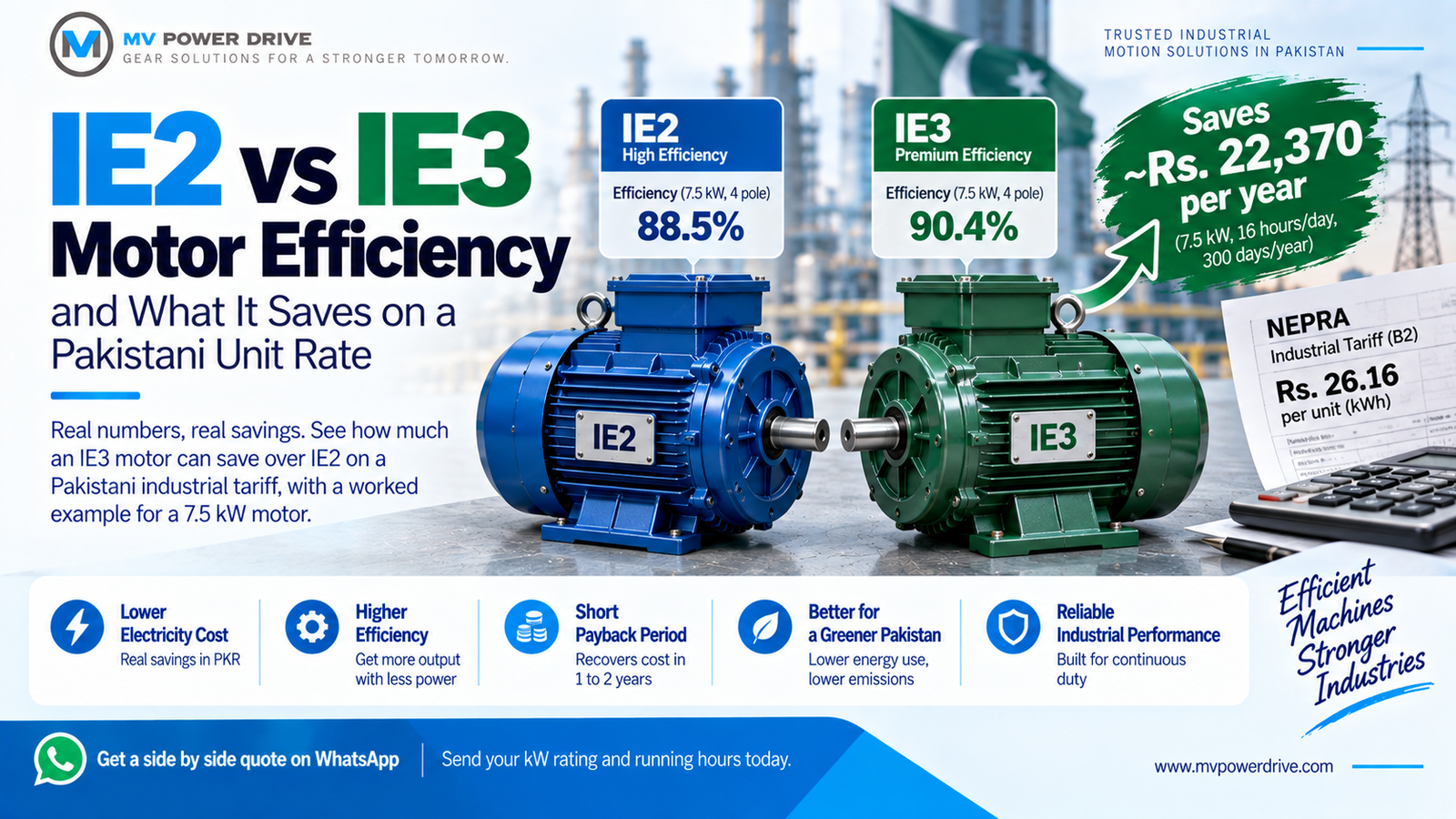
IE stands for International Efficiency, and the classes (IE1 through IE4) are defined under IEC 60034-30-1, the international standard that sets minimum efficiency levels for three phase induction motors by power rating and pole count. IE1 is standard efficiency, IE2 is high efficiency, IE3 is premium efficiency, and IE4 is super premium. For a typical 7.5 kW, four pole motor, published IEC figures put IE2 efficiency around 88 to 89 percent and IE3 around 90.4 percent, a gap of roughly 1.5 to 2 percentage points that sounds small until it is multiplied across thousands of running hours a year.
The Rupee Math on a Pakistani Industrial Tariff
As of the NEPRA tariff notification effective February 2026, medium sized industrial consumers in the B2 category (25 to 500 kW connected load) pay an average energy charge of Rs. 26.16 per unit (kWh). Using that rate on a 7.5 kW motor running 16 hours a day, 300 days a year, roughly 36,000 kWh of energy passes through that motor annually.
At 88.5 percent efficiency (a typical IE2 figure for this size), the electrical input required to deliver that output works out to about 40,678 kWh a year. At 90.4 percent efficiency (IE3), the same output requires about 39,823 kWh. The difference, roughly 855 kWh a year, comes to approximately Rs. 22,370 a year in electricity cost on a single motor, at the current B2 tariff.
That is one motor. A production line running ten motors of similar size at the same duty cycle would see the IE2 to IE3 gap add up to well over Rs. 200,000 a year, a figure that typically covers the entire price premium of upgrading to IE3 motors within the first one to two years of operation, after which the higher efficiency motor is saving money for the rest of its working life.
Why the Gap Matters More on Continuous Duty
The savings calculation above assumes 16 hours a day, which is realistic for many textile, sugar and packaging operations running multiple shifts. A motor running only a few hours a day intermittently sees a proportionally smaller annual saving, since the efficiency gap only compounds while the motor is actually drawing power. If your application runs close to continuously, IE3 pays for its premium faster. If it runs a handful of hours a week, the payback period stretches out and the decision becomes less clear cut.
Scaling the Calculation to Your Own Motor
The worked example above used a 7.5 kW motor at 16 hours a day, but the same method scales to any size or duty cycle. Take the motor’s kW rating, multiply by daily running hours and days per year to get total output energy delivered, then divide by each efficiency figure to find electrical input required at that class. The difference in input energy, multiplied by the current NEPRA tariff for your consumer category, gives the annual rupee saving. For a smaller 2.2 kW motor running 8 hours a day, 300 days a year, the same IE2 versus IE3 efficiency gap produces a proportionally smaller saving, in the range of a few thousand rupees annually rather than tens of thousands, simply because there are fewer kWh passing through the motor each year. This is why the efficiency class decision matters most on your largest, longest running motors first, and least on small, intermittently used equipment where the payback period on the price premium may never fully materialize within the motor’s working life.
What to Check Before You Buy
Efficiency class should be stated on the motor nameplate and in the supplier’s documentation. Not every motor sold in Pakistan carries a verified IE rating, and unbranded or grey market units sometimes claim an efficiency class without the test documentation to back it up. For continuously running equipment, that verification is worth insisting on, since the entire savings case depends on the motor actually performing at its stated class, not just being labeled as one.
MV Power Drive supplies electric motors across the IE2 and IE3 range depending on application and budget, and we can quote both options side by side so you can see the price difference against the calculated running cost before deciding. If your motor is driving equipment through a gearbox, our guide to electric motor frame size covers how efficiency class interacts with frame size selection.
Get a Side by Side Quote
If you want the exact rupee comparison for your specific motor size and running hours rather than the worked example above, send us your kW rating and daily operating hours on WhatsApp. MV Power Drive will quote both IE2 and IE3 options against your actual duty cycle so the decision is based on your numbers, not an average one.
Related reading: electric motor price in Pakistan and industrial duty electric motors.