
When requesting a quotation for an industrial chain, “half-inch chain” or “chain for a 3 kW motor” is not a complete specification. The supplier also needs to identify the chain series, number of strands, sprocket arrangement and operating conditions. Manufacturer selection procedures consider transmitted power, shaft speed, sprocket teeth and application factors together, rather than selecting a chain from pitch or motor power alone.
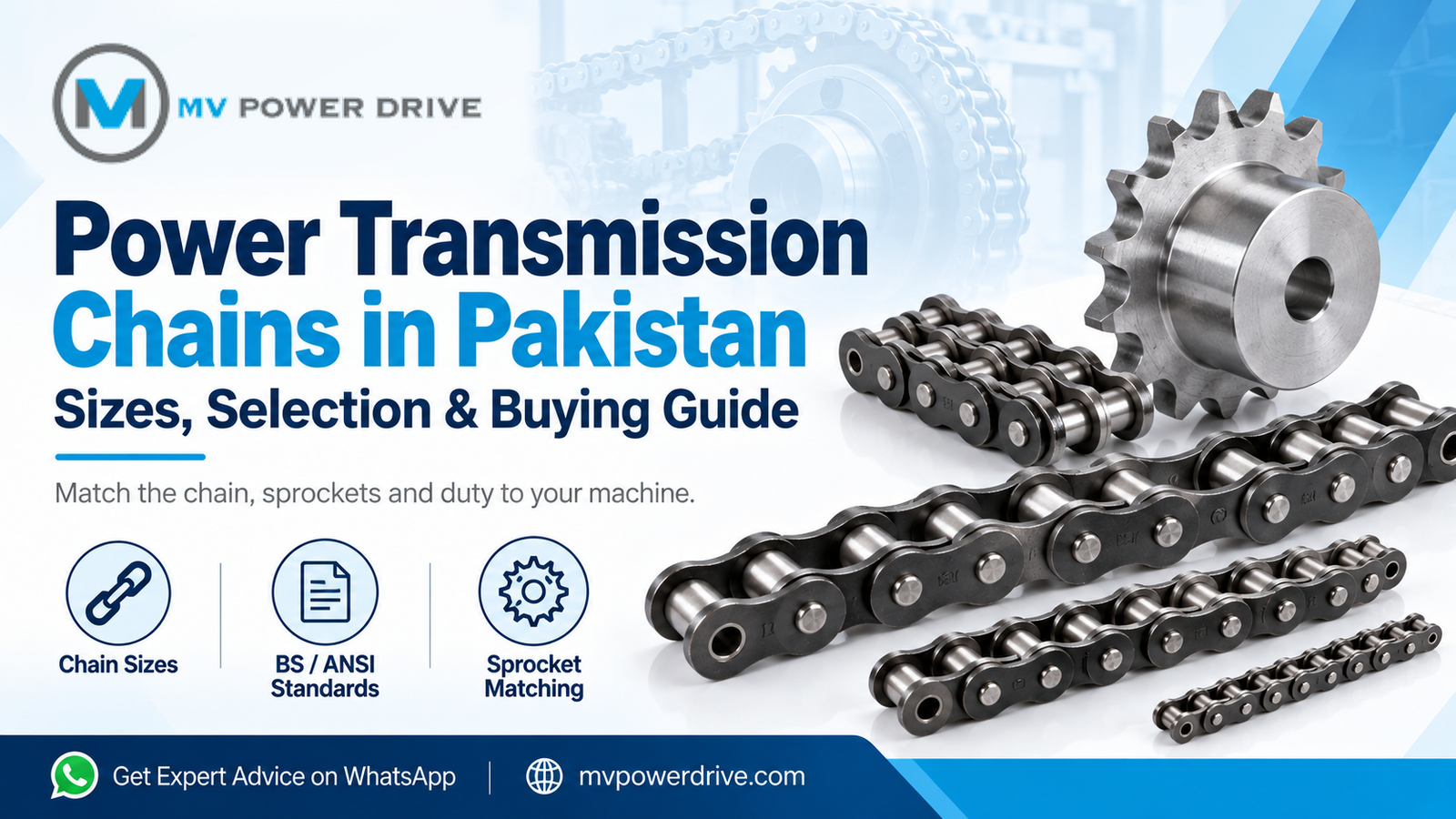
Choosing a power transmission chain supplier in Pakistan should therefore involve more than comparing a price per metre. Ask whether the quotation identifies the correct chain and whether its dimensions and performance have been checked against the existing drive. A clear specification makes quotations easier to compare and reduces uncertainty when the maintenance team begins installation.
MV Power Drive supplies industrial chains for power transmission and conveying, alongside motors, reducers and other drive components. This guide explains how to identify roller chain sizes, distinguish different chain standards, match sprockets and prepare a useful purchasing enquiry.
What Is a Power Transmission Chain?
A power transmission chain transfers motion between shafts through sprockets. In a roller-chain drive, the chain contains link plates, pins, bushes and rollers. These components have different functions: the plates carry tension, the pin-and-bush joints allow articulation, and the rollers engage with the sprocket teeth. The chain must withstand repeated operating loads, not merely a single pull before breaking.
For purchasing purposes, begin by explaining what the chain does in the machine. Is it connecting a gearbox output to another shaft, driving conveyor rollers, or carrying attachments that move the product? Include a photograph of the complete installation rather than sending only a close-up of one link. That context helps the supplier identify which dimensions and operating conditions need checking.
Transmission chain and conveyor chain are not the same enquiry
A chain that transmits power to a conveyor shaft is not necessarily the same product as the chain that carries material along the conveyor. Conveyor chains can have different roller arrangements, attachments and load-supporting functions. Their selection also depends on how the material is supported or moved, making the conveying arrangement an important part of the specification.
Describe the function clearly in your enquiry. For example, “roller chain between gearbox and conveyor drive shaft” is more informative than “conveyor chain.” For attachment chains, include the attachment drawing, spacing and orientation so the supplier does not quote a plain transmission chain where a specialised conveying chain is required.
How to Read an Industrial Roller Chain Size
Chain markings provide a useful starting point, but the complete designation matters. In the commonly used B-series numbering system, a code such as 08B-2 identifies a half-inch-pitch chain with two strands. The number after the hyphen distinguishes the strand arrangement: single-strand chains are commonly called simplex, two-strand chains duplex, and three-strand chains triplex.
Record the full marking from the existing chain, packaging or machine documentation. Keep any manufacturer-specific suffixes, because they may identify a construction or material variant. Photograph the connecting link as well as the main chain, and ask the supplier to confirm that the proposed connecting components belong to the selected product series.
Common BS/DIN roller chain dimensions
The following table gives reference dimensions published in Tsubaki’s BS/DIN roller-chain range. These figures help identify the dimensional family; they are not power ratings or confirmation that a particular chain is suitable for your machine. Dimensions are in millimetres.
| Simplex chain designation | Pitch | Roller diameter | Width between inner plates |
|---|---|---|---|
| 06B-1 | 9.525 | 6.35 | 5.72 |
| 08B-1 | 12.70 | 8.51 | 7.75 |
| 10B-1 | 15.875 | 10.16 | 9.65 |
| 12B-1 | 19.05 | 12.07 | 11.68 |
| 16B-1 | 25.40 | 15.88 | 17.02 |
| 20B-1 | 31.75 | 19.05 | 19.56 |
Use these dimensions as an identification reference, then request the drawing and rating information for the actual product being offered. A replacement enquiry should identify the chain series and strand count explicitly rather than relying on appearance.
BS/DIN vs ANSI Chain: Why Pitch Alone Is Not Enough
Two chains can share the same pitch while having different roller diameters and internal widths. For example, Tsubaki lists both 08B-1 and ANSI No. 40 with a 12.70 mm pitch, but its 08B-1 has an 8.51 mm roller diameter, while its No. 40 has a 7.92 mm roller diameter. That difference is enough to show why “half-inch chain” does not uniquely identify the product.
When replacing a chain on existing sprockets, confirm the original standard and complete designation. Do not approve a substitution merely because a few links appear to sit over the teeth. Ask the supplier to check the proposed chain against the sprocket specification, including the strand arrangement and relevant dimensions.
The same discipline applies to connecting links. Supply the chain manufacturer and series when ordering spare links, rather than asking for a generic link of the same apparent pitch. Treat compatibility as something to confirm from product documentation, not something to infer from a photograph.
How to Select the Right Power Transmission Chain
For a replacement, begin with the machine’s existing specification and establish why the old chain is being replaced. For a new drive, start with the operating requirement and layout. Manufacturer selection procedures use the application, transmitted power, shaft speeds, sprocket arrangement and available space to determine a suitable chain—not just the motor nameplate.
Check the shaft speed where the chain operates
Record the speed of the shaft carrying the driving sprocket. When the chain is downstream of a gearbox, distinguish that speed from the motor speed. Also state whether the drive operates at one fixed speed or over an adjustable range.
For conveyor projects, our electric motor selection guide for conveyor systems provides the wider application checklist. Use it to organise the motor and load information before requesting the chain-drive assessment.
Include starting conditions and load changes
Tell the supplier whether the machine starts under load, reverses, experiences shock or operates with a varying load. Tsubaki’s selection method uses application coefficients to account for operating conditions, so a smooth, steady drive should not automatically be assessed in the same way as a drive subjected to impact. en.ttnet.tsubakimoto.co.jp
Keep the chain selection assessment separate from the gearbox assessment. You can use our service factor guide to understand why operating conditions matter, but do not copy a gearbox service-factor value into a chain calculation without checking the chain manufacturer’s procedure.
Choose simplex, duplex or triplex from the rating—not appearance
Multiple-strand chains can provide greater transmission capacity within a particular layout, but the increase is not automatically proportional to the number of strands. Tsubaki states that the load is not shared perfectly between strands and therefore uses a multiple-strand factor when calculating capacity. A duplex chain should not simply be assumed to carry twice the power of its simplex equivalent.
For a replacement, preserve the original strand arrangement unless the complete drive is being reassessed. For a new installation, ask the supplier to compare suitable chain-and-sprocket combinations within the available space. Include the guard clearance and shaft arrangement in that review.
Match the Chain and Sprockets as One System
Sprockets must be selected for the chain’s model and specification, not solely by their outside diameter. The tooth count, chain series and strand arrangement are part of the selection, while the sprocket’s bore and mounting details must suit the shaft. Tsubaki’s sprocket guidance explicitly starts with the chain model and specifications.
When requesting industrial sprockets, provide the chain designation, tooth count, shaft diameter and required bore or bush arrangement. Include a drawing or sample details for replacement work. A sprocket can belong to the correct chain family while still being unsuitable for the existing shaft connection.
Inspect the sprockets when assessing a worn chain. Tsubaki warns that installing a new roller chain on worn sprockets accelerates wear and recommends replacing the sprockets with the chain. Follow the selected manufacturer’s maintenance guidance rather than automatically retaining old sprockets to reduce the initial purchase cost.
Worked Example: Gearbox Ratio and Sprocket Ratio
Consider an illustrative drive with a motor operating at 1,400 rpm and a gearbox with an exact 30:1 reduction. Assume the gearbox output carries a 19-tooth driving sprocket, which drives a 38-tooth sprocket on the machine shaft. These figures demonstrate the speed calculation only; they are not a complete chain selection.
The gearbox output speed is:
1,400 ÷ 30 = 46.67 rpm
The chain drive then provides a further reduction:
Chain-drive ratio = Driven sprocket teeth ÷ Driving sprocket teeth
38 ÷ 19 = 2:1
The resulting machine-shaft speed is:
46.67 ÷ 2 ≈ 23.33 rpm
The overall reduction is therefore 30 × 2 = 60:1. This illustrates why the gearbox ratio and sprocket ratio must be considered together. Selecting a gearbox to produce the final machine speed, then adding an unaccounted-for sprocket reduction, changes the result.
The calculation does not establish the required chain pitch, strand count or load capacity. Those still need the transmitted power, operating conditions and manufacturer’s selection data. When comparing gear reducers or complete gear motors, include the downstream sprocket arrangement in the enquiry rather than treating it as an unrelated component.
Tensile Strength Is Not the Allowable Operating Load
A high breaking-load figure can look reassuring, but it is not the load at which an industrial chain should continuously operate. Tsubaki’s catalogue distinguishes minimum tensile strength, the failure point under a single applied tensile load—from allowable operating load. Selecting a chain by breaking strength alone therefore overlooks the conditions under which it repeatedly transmits power.
Ask for the manufacturer’s applicable power rating or allowable-load selection, together with the assumptions used. A quotation stating only “high tensile strength” leaves an important gap. Also avoid transferring a rating from one manufacturer’s chain to another product merely because both have the same nominal dimensions; the quoted product should be supported by its own technical information.
This is particularly important when comparing an established specification with an alternative offered at a lower price. Request enough documentation to understand what is changing before approving the substitution.
Material, Environment and Lubrication
The operating environment can change the appropriate chain specification. Dust, abrasives, cleaning chemicals, moisture and elevated temperature should all be included in the enquiry. Environmentally resistant chains are not automatically direct performance substitutes for standard chains: Tsubaki notes that some corrosion-resistant versions have lower allowable loads and require their own selection checks.
Do not choose stainless steel simply because it sounds like an upgrade. First explain the exposure and cleaning process, then compare the proposed material with the required load capacity. Similarly, describe abrasive contamination rather than assuming that a heavier chain will solve a wear problem.
Lubrication is also part of the specification. Conventional roller-chain lubrication needs to protect the articulating joints; wear between pins and bushes contributes to chain elongation. An externally oily appearance is not, by itself, proof that the required joint surfaces are receiving suitable lubrication. Follow the manufacturer’s instructions for lubricant and delivery method.
Where routine lubrication is difficult or undesirable, purpose-designed lube-free chains may be worth assessing. These use features such as lubricant-impregnated bushes; they are not ordinary chains operated without oil. Their compatibility and operating limits still need checking, especially for multi-strand replacements.
Why a Replacement Chain May Wear Out Again
Replacing the chain without reviewing the drive can leave the underlying problem unresolved. Manufacturer troubleshooting guidance identifies incompatible chain and sprockets, overload, incorrect installation, excessive or insufficient slack, and worn components as possible causes of poor operation. The correct response depends on the cause rather than automatically moving to a larger chain.
Record what happened before the replacement was needed. Did the chain become noisy, ride up on the teeth, develop stiff joints or require repeated adjustment? Include photographs and the approximate operating period in the enquiry. These observations help the supplier distinguish a straightforward replacement from a drive that needs a closer technical review.
Also record any machine changes. A different operating speed, added load or revised production cycle should be disclosed rather than assuming that the old chain specification remains the right reference. Ask for the replacement to be checked against the machine’s present operating conditions.
How to Compare Industrial Chain Quotations
A useful comparison starts with the same specification for every supplier. Request the chain standard, manufacturer, product series, strand count, material and supply length in writing. State whether you need an open length, an assembled endless chain, connecting links or attachments. Without those details, the quotations may describe different products even where the headline chain size looks similar.
Compare the supply basis as carefully as the unit price. Ask whether the quotation includes connecting components, cutting or assembly, taxes and delivery. For sprockets, identify whether the price is for a plain bore, finished bore or another agreed mounting arrangement. This makes the commercial comparison clearer without relying on assumptions about what the supplier normally includes.
For production-critical equipment, request the technical documentation and confirm replacement availability before committing to a new specification. Keep the approved chain designation and drawing in the maintenance record so the next order does not begin with another uncertain identification exercise.
What to Send a Power Transmission Chain Supplier
A quotation request should combine identification, operating conditions and supply requirements. A photograph is helpful, but a photograph with the chain marking, dimensions and machine details is much more useful. For an existing drive, include the chain and both sprockets rather than showing only the most accessible component.
Send these four groups of information:
- Chain identification: existing marking, manufacturer, pitch, roller diameter, inner width, strand count and any attachments.
- Drive details: transmitted power or load, driving-shaft rpm, sprocket tooth counts, shaft-centre distance and required machine speed.
- Operating conditions: application, running hours, starting or reversing conditions, temperature, contamination and lubrication arrangement.
- Order details: required length or number of pitches, connecting links, sprockets, quantity and delivery city.
A useful replacement enquiry might read: “Please quote against the attached 12B-2 marking and photographs. The chain operates between the gearbox and conveyor drive shaft. Please confirm the dimensions, connecting link and suitability against the attached speed and duty information before offering a replacement.” That is a clearer starting point than asking only for a price on a “heavy-duty conveyor chain.”
Frequently Asked Questions
Can I select a chain from motor kW alone?
No. The shaft speed, sprocket arrangement and operating conditions also form part of the manufacturer’s selection procedure. Provide the motor information, but make clear where the chain is installed in the drive and what speed it actually runs at.
Are 08B and ANSI No. 40 the same chain?
They share a nominal half-inch pitch, but their other dimensions differ. Tsubaki’s tables show different roller diameters for the two series, so they should not be treated as equivalent solely because the pitch matches. Confirm the chain and sprocket specification before substitution.
Should I order a chain sample or use photographs?
For an uncertain replacement, provide both dimensional information and clear photographs, and offer a sample for identification where practical. Include the machine’s operating details as well. Identifying what was previously installed and confirming what should be installed are two separate checks.
Where can I request industrial chains and sprockets in Pakistan?
MV Power Drive lists both industrial chains and matching sprocket products within its power-transmission range. Send the required specification, quantity and delivery city, and request confirmation of the offered product, availability and lead time before ordering.
Confirm the Chain Specification Before Ordering
A well-prepared chain order identifies the product, its mating sprockets and the operating conditions it must handle. Keep the dimensions, performance requirements and commercial details together throughout the quotation process. That gives the purchasing team and maintenance team the same reference when reviewing alternatives.
Contact MV Power Drive with your existing chain marking, photographs, sprocket details and application information. For a new installation, include the required speed and load so the chain, sprockets and geared drive can be reviewed together before you approve the specification.