
When you order an electric motor, gearmotor, or gearbox, you may come across terms like B5 flange and B14 flange. If you are not familiar with these codes, they can be confusing.
The easiest way to understand them is this:
B5 and B14 describe how the motor or gearbox is mounted and connected through a flange.
They are commonly used when:
- mounting an electric motor directly to a machine
- connecting a motor to a gearbox
- building a gearmotor
- replacing an existing motor or gearbox
- selecting NMRV, helical and other geared drive configurations
The important point is that B5 and B14 are not two different gearbox ratios or power ratings. They are mounting configurations, and choosing the wrong one can mean that the motor or gearbox simply does not physically fit your machine.
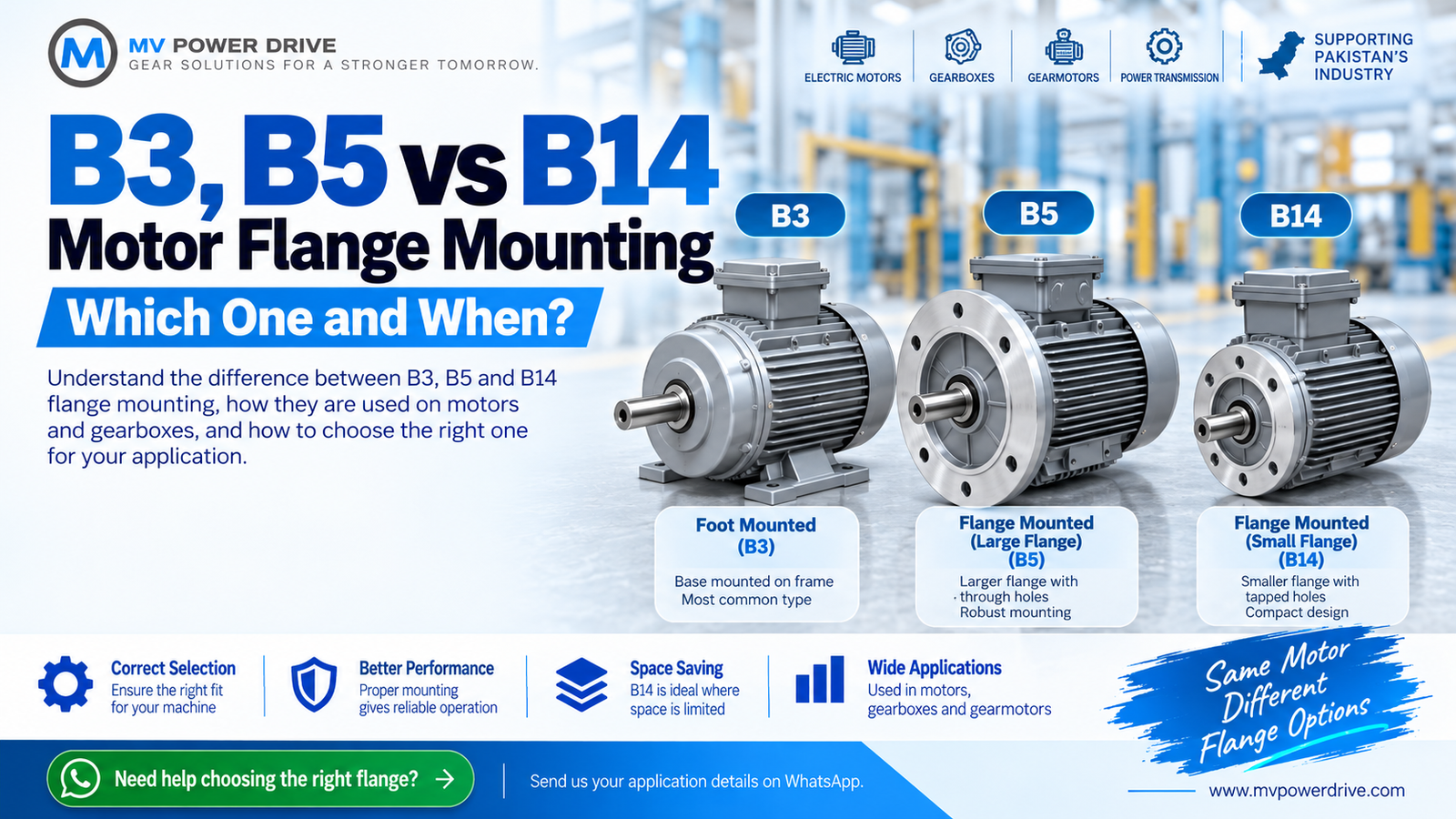
First: What Does B5 vs B14 Actually Mean?
Think of the flange as the connection point between the motor, gearbox, or machine.
The two common configurations look similar at first, but the way the bolts and flange are designed is different.
B5 flange
A B5 flange is the larger flange arrangement. It uses a larger flange diameter and mounting holes that allow the unit to be secured to the mating equipment.
B5 is commonly used where a larger, more robust mounting interface is required.
B14 flange
A B14 flange, often called a small flange or semi-flange, is more compact. The gearbox or motor has threaded holes in the flange, allowing the mating component to be bolted directly into the flange.
B14 is useful where installation space is limited and a more compact mounting arrangement is required.
The simple way to remember it
B5 = larger flange
B14 = smaller, more compact flange
But there is an important detail: you cannot choose between B5 and B14 simply because one looks stronger or smaller. The flange on the mating component has to match.
Where Do You Actually Find B5 and B14?
This is where many buyers get confused.
B5 and B14 are not limited to NMRV worm gearboxes.
You can encounter these mounting configurations in:
- Electric motors
- Worm gearboxes
- Helical gearboxes
- Gearmotors
- Servo motor and gearbox combinations
- Other industrial drive assemblies
For example, you might have:
Motor → Gearbox → Conveyor
or:
Motor + Gearbox → Machine
The motor and gearbox have to be mechanically compatible at their connection point.
Example 1: Connecting a Motor to a Gearbox
Imagine you have an electric motor that needs to drive an NMRV worm gearbox.
The basic arrangement looks like:
Electric Motor → Flange/Adapter → NMRV Gearbox → Machine
If the gearbox is designed to accept a particular motor flange configuration, the motor and gearbox need to match that interface.
So you cannot simply say:
“I need an NMRV gearbox for a 2.2 kW motor.”
You may also need to specify:
- Motor power
- Motor frame size
- Motor RPM
- Gearbox ratio
- Gearbox body size
- Motor mounting/flange configuration
This is why two motors with the same kW rating are not necessarily interchangeable.
Example 2: The Motor Itself Can Be B5 or B14
This is another important point.
You may be buying only a motor, without a gearbox.
The motor itself can have a B5 or B14 mounting arrangement depending on the application and machine design.
For example:
B5 motor → Machine
or
B14 motor → Machine
In this situation, there is no gearbox involved. The B5/B14 specification is simply telling you how the motor needs to be mounted to the machine.
So when someone asks:
“Should I order a B5 or B14 motor?”
The answer depends on the mounting arrangement of the machine, not on the motor’s kW rating alone.
Example 3: Motor + Gearbox as One Drive
In many industrial applications, the motor and gearbox are supplied as a combined gearmotor.
For example:
Motor → NMRV Gearbox → Conveyor
The gearbox reduces the motor speed and increases the available output torque.
But before ordering the complete assembly, you still need to make sure the motor-to-gearbox connection is compatible.
This is why B5/B14 becomes important when specifying a gearmotor.
The same principle applies to other gearbox types, including NMRV worm gearboxes and helical gearboxes.
B5 vs B14: What’s the Actual Difference?
| Feature | B5 | B14 |
|---|---|---|
| Flange size | Larger | Smaller |
| Mounting style | Larger flange arrangement | Compact flange arrangement |
| Space requirement | More | Less |
| Typical use | Larger/robust mounting arrangements | Compact installations |
| Can be used with motors? | Yes | Yes |
| Can appear in geared drive systems? | Yes | Yes |
| Must match mating equipment? | Yes | Yes |
The most important row is the last one.
The flange has to match the component you are connecting it to.
What If I Have a Gearbox and Need to Connect a Motor?
This is probably the most useful question for someone buying from a gearbox supplier.
Suppose you already have an NMRV gearbox and want to install a motor.
Before ordering the motor, check:
- Motor power
- Motor frame size
- Motor shaft size
- Motor RPM
- Flange configuration
- Gearbox input/interface dimensions
For example, the gearbox may be suitable for your required torque and ratio, but the motor may still be mechanically incompatible with the gearbox input.
That’s why power and flange type should be checked together.
What If I Am Replacing an Existing Motor?
This is even easier.
If you are replacing an existing motor, don’t guess whether you need B5 or B14.
Check the old motor.
Look at:
- The nameplate
- Flange diameter
- Bolt-hole arrangement
- Shaft dimensions
- Frame size
- Mounting position
If the replacement motor needs to fit directly into the existing machine, the new motor needs to have the correct mounting arrangement.
A motor with the correct kW and RPM can still be the wrong motor if its mounting configuration does not match.
What If I Am Replacing a Gearbox?
The same principle applies.
Suppose your existing machine has an NMRV gearbox and you want to replace it.
Don’t specify the replacement using only:
“NMRV 75, 30:1.”
You should also check the physical mounting and interface dimensions.
Depending on the configuration, you may need to confirm:
- Gearbox body size
- Ratio
- Output shaft
- Output flange
- Input configuration
- Motor flange/interface
- Mounting position
The NMRV worm gearbox range includes different configurations, so the correct gearbox is not determined by the NMRV number alone.
B5 vs B14: Which One Should You Choose?
There is no universal answer that B5 is better than B14 or vice versa.
The right choice is the one that matches your machine or the component you are connecting.
Choose B5 when:
- Your machine is designed for a larger flange arrangement
- You need the corresponding B5 mounting interface
- The existing motor or gearbox uses B5
- The installation provides enough space for the larger flange
Choose B14 when:
- Your machine is designed for the smaller flange arrangement
- Compact installation is important
- The existing motor or gearbox uses B14
- The mating component is designed for B14
Do not choose B5 simply because it is larger, or B14 simply because it is more compact.
The mounting interface must match.
What Happens If You Order the Wrong Flange?
This is where a small specification mistake can become an expensive problem.
Imagine you order:
Motor: 2.2 kW
RPM: 1400
Correct shaft: Yes
But you order the wrong flange configuration.
The motor may have the correct electrical specifications and still not physically mount to your machine or gearbox.
You may then need:
- An adapter
- Additional machining
- A modified mounting plate
- A replacement motor or gearbox
- Additional installation time
In some cases, the wrong mounting arrangement can also create alignment problems.
That’s why it is much better to confirm the flange before the order is placed.
B5/B14 Is Only One Part of Gearbox Selection
Another common mistake is focusing so much on the flange that other specifications get ignored.
For a gearbox or gearmotor, you still need to consider:
Motor → kW + RPM
Gearbox → Ratio + Body Size + Torque
Mounting → B5/B14 + mounting dimensions
For example, choosing an NMRV 75 because the flange fits does not automatically mean it has enough torque for the application.
If you are deciding between different NMRV body sizes, our guide on NMRV 63, 75 and 90 explains how body size affects torque capacity and load suitability.
And if you are still comparing gearbox construction and mounting options, our broader gear reducers range covers different gearbox types and configurations.
Don’t Confuse Motor Mounting With Gearbox Output Mounting
One more point is worth making because it causes confusion in gearbox quotations.
When someone says “B5 gearbox” or “B14 gearbox,” you should confirm which interface they are referring to.
A geared drive can have several different connection points:
Motor → Gearbox input → Gearbox output → Driven machine
The motor-to-gearbox interface is different from the gearbox’s output connection to the machine.
So a quotation should ideally specify the complete configuration rather than simply saying:
“B5 gearbox.”
For example:
NMRV gearbox + motor + required input flange + output configuration
This removes ambiguity before the order is processed.
How to Confirm Your B5 or B14 Configuration
If you already have the motor or gearbox, the easiest approach is to send your supplier:
- A clear photo of the unit
- A photo of the nameplate
- Flange face photo
- Motor/gearbox frame size if available
- Shaft dimensions if available
This is much safer than trying to identify B5 or B14 from appearance alone.
Order the Correct Flange the First Time
B5 and B14 are not about which option is “better.” They are about which mounting interface your motor, gearbox and machine require.
Whether you are buying an electric motor on its own, a motor + NMRV gearbox, or another geared drive such as a helical gearbox, confirm the mounting configuration before ordering.
For NMRV applications, our NMRV worm gearbox range covers different configurations, while our broader gear reducers range gives you options beyond worm gearboxes.
If you are also selecting the gearbox body size, see our guide comparing NMRV 63, 75 and 90.
You can also use our NMRV worm gearbox size guide and electric motor frame size chart to check the other dimensions before finalizing your selection.
Not sure whether your application needs B5 or B14? Send MV Power Drive a photo of your existing motor/gearbox and its nameplate on WhatsApp. We can help confirm the correct mounting configuration before you order.