
The NMRV number stamped on a worm gearbox housing is its body size, and it is the single most important number on the spec sheet once you have already settled on a ratio. Three sizes come up constantly in quotes for Pakistani factories: NMRV 63, NMRV 75 and NMRV 90. They look similar side by side and the price difference is not huge, which is exactly why buyers sometimes pick the wrong one on gut feel rather than on load.
What the Body Size Actually Controls
Body size determines the physical size of the worm and worm wheel inside the housing, which in turn sets the maximum torque and power the gearbox can transmit at a given ratio without premature wear. A larger body size handles more torque at the same ratio, but it also costs more, weighs more, and takes up more mounting space, so going bigger “to be safe” is not free.
Across the full NMRV range MV Power Drive stocks, body sizes run from 25 up to 150, with torque capacity spanning 2.6 to 1760 Nm and power range 0.06 kW to 15 kW depending on size and ratio. The 63, 75 and 90 sizes sit in the middle of that range and cover the majority of conveyor, mixer and general production drive applications we quote.
NMRV 63, 75 and 90 Compared
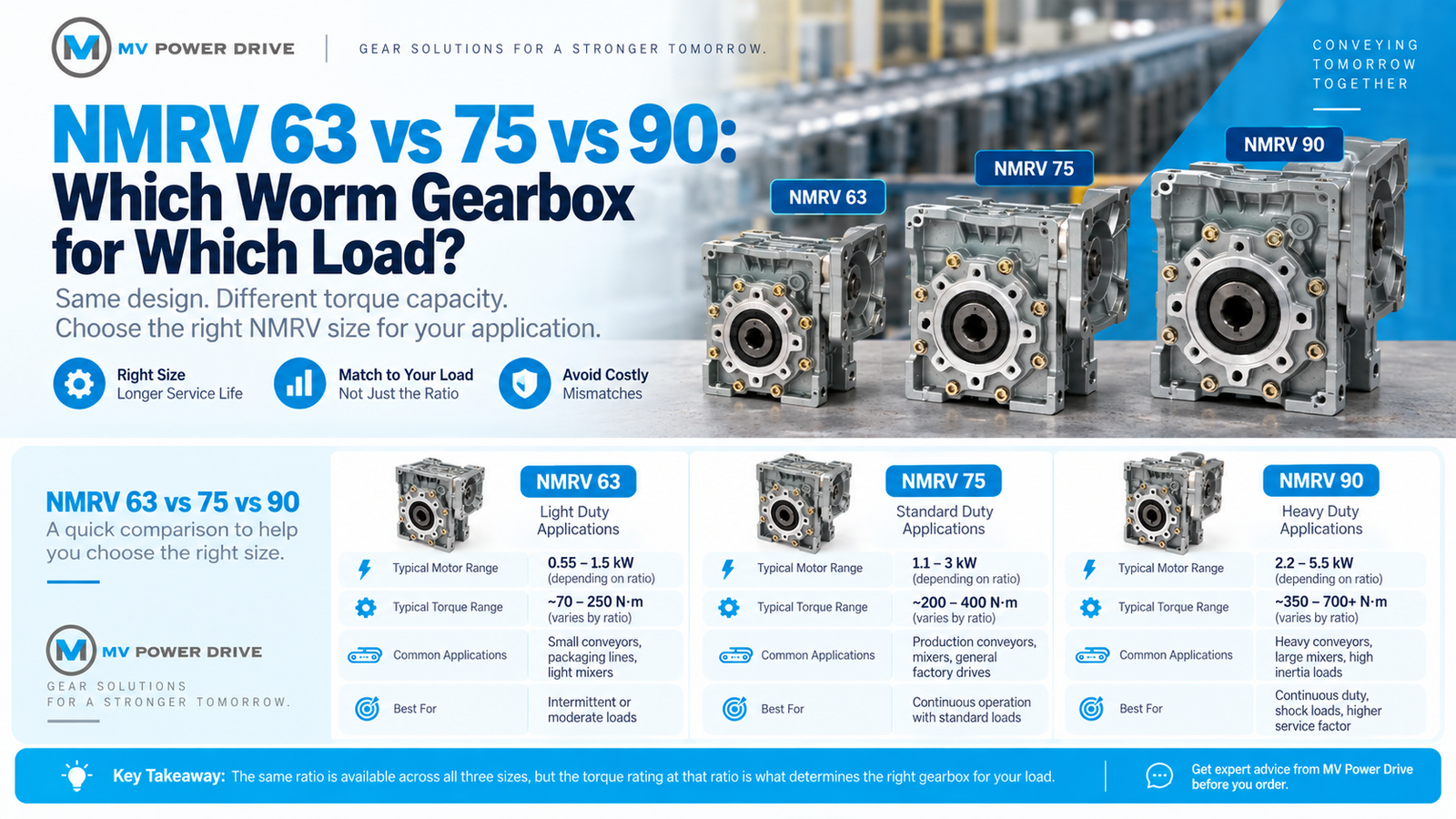
NMRV 63 is the smaller of the three and suits lighter duty applications, typically motors in the 0.55 to 1.5 kW range depending on ratio. It is a common choice for smaller conveyors, packaging line indexing, and light mixing applications where torque demand is moderate.
NMRV 75 steps up in torque capacity and is the size we see requested most often for standard production conveyors and mid sized mixers, typically paired with motors from 1.1 to 3 kW depending on the ratio selected. It represents a practical middle ground: enough torque capacity for most factory floor applications without the extra bulk of a size 90 unit.
NMRV 90 handles noticeably more torque and is specified when the driven load is heavier, motors from roughly 2.2 to 5.5 kW range depending on ratio, or when the application runs continuously under sustained load rather than intermittently. If your application involves frequent starts and stops or shock loading, sizing up to a 90 even when a 75 might mathematically cover the torque is often the safer call, since shock loads eat into a gearbox’s fatigue life faster than steady loads of the same average torque.
Matching Ratio to Body Size
A critical point buyers miss: the same ratio is available across multiple body sizes, but the torque rating at that ratio differs significantly between sizes. A 1:30 ratio NMRV 63 and a 1:30 ratio NMRV 90 are not interchangeable just because the ratio matches. The torque capacity at that ratio is what actually determines whether the gearbox survives your application, so always confirm torque rating at your specific ratio, not just the ratio number itself, before finalizing a size.
MV Power Drive’s NMRV catalogue covers single gear standard ratios from 1:5 through 1:100, with the full 2.6 to 1760 Nm torque range distributed across the 25 through 150 body sizes, so the same output speed target can often be met by more than one size, with torque headroom being the deciding factor between them.
When to Move Beyond a Single NMRV
If your ratio requirement exceeds what a single reduction NMRV can deliver efficiently, or if you need a ratio well beyond 1:100, a double gear NMRV configuration extends the achievable ratio range significantly, and MV Power Drive stocks NMRV double gear variants for exactly this situation rather than forcing an oversized single reduction unit into a job it was not designed for.
Comparing the Three Sizes at the Same Ratio
To make the difference concrete, consider all three sizes at the same 1:30 ratio, a common choice for standard conveyor and mixer drives. An NMRV 63 at 1:30 is typically rated for a modest torque ceiling suited to light duty, intermittent applications. Step up to an NMRV 75 at the same 1:30 ratio and the torque ceiling rises meaningfully, enough headroom for most continuous duty conveyor applications running standard shock loads. Move to an NMRV 90 at 1:30 and the torque ceiling rises again, now suited to heavier mixers, higher inertia loads, or applications where a service factor above 1.25 has been calculated. The ratio number alone tells you nothing about which of these three fits your application. Only the torque rating at that specific ratio, checked against your calculated requirement including service factor, tells you which size actually belongs on the order.
This is also why two suppliers quoting “NMRV 75, ratio 1:30” are not automatically quoting the same product. Manufacturing tolerances, gear material and housing design vary between manufacturers even within a nominally identical size and ratio designation, which is part of why sourcing through an established supplier with documented specifications, rather than an unbranded import with no torque rating on the datasheet, matters more on this decision than it might first appear.
Which is better, NMRV 63 or NMRV 75?
Neither is universally better. NMRV 63 is the better choice for lighter loads and smaller motors, while NMRV 75 is better when you need higher torque capacity, continuous-duty performance, or additional load headroom. The correct choice should be based on the required output torque at your selected ratio, not simply on motor size or price.
Request the Right Size for Your Load
Choosing between NMRV 63, 75 and 90 comes down to matching torque capacity to your actual load, not picking the size that looks proportionate to the motor. See our full NMRV worm gearbox range, or browse gear reducers more broadly if you are still deciding between worm and helical construction. For a full walkthrough of the ratio and torque math itself, our guide to calculating gearbox ratio for a conveyor drive covers the formula step by step. Send us your motor kW, target ratio and duty cycle on WhatsApp and we will confirm the correct body size before you order.
Related reading: NMRV worm gearbox size guide, NMRV gearbox price in Pakistan and service factor in gearbox selection.